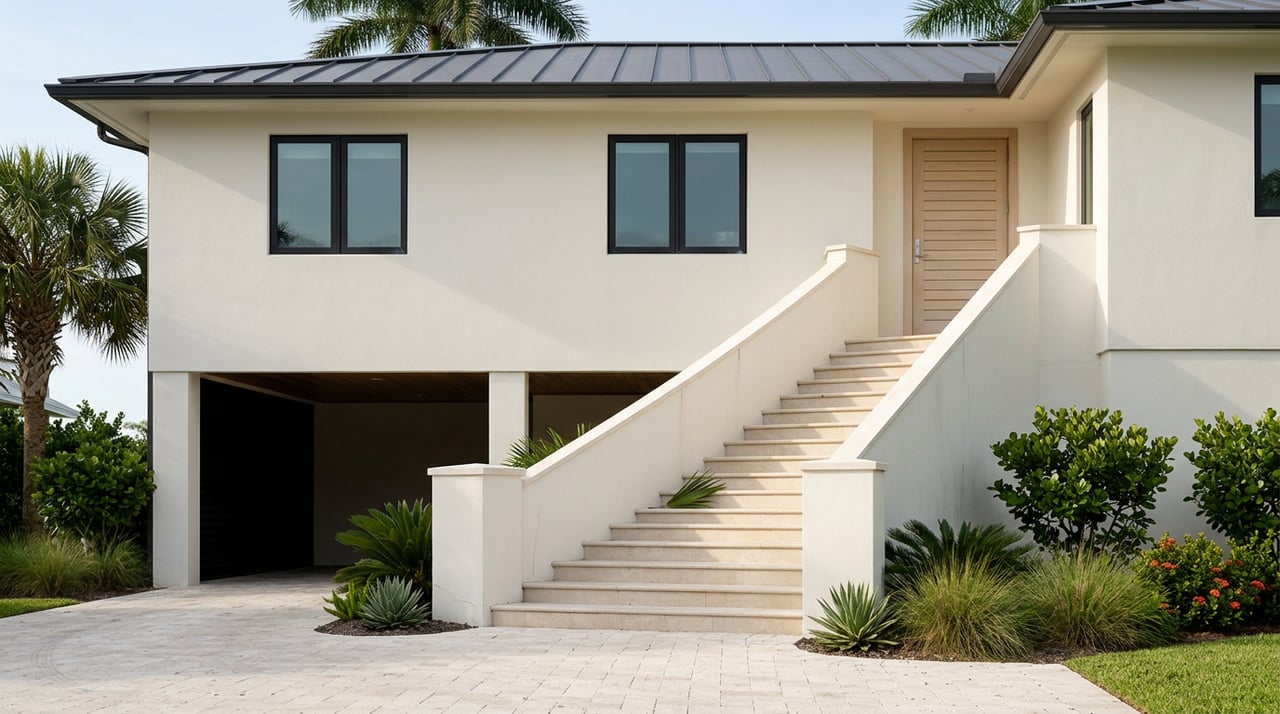
Isles of Capri Waterfront Homes: What Your Boat Needs
August 6, 2026
August 6, 2026
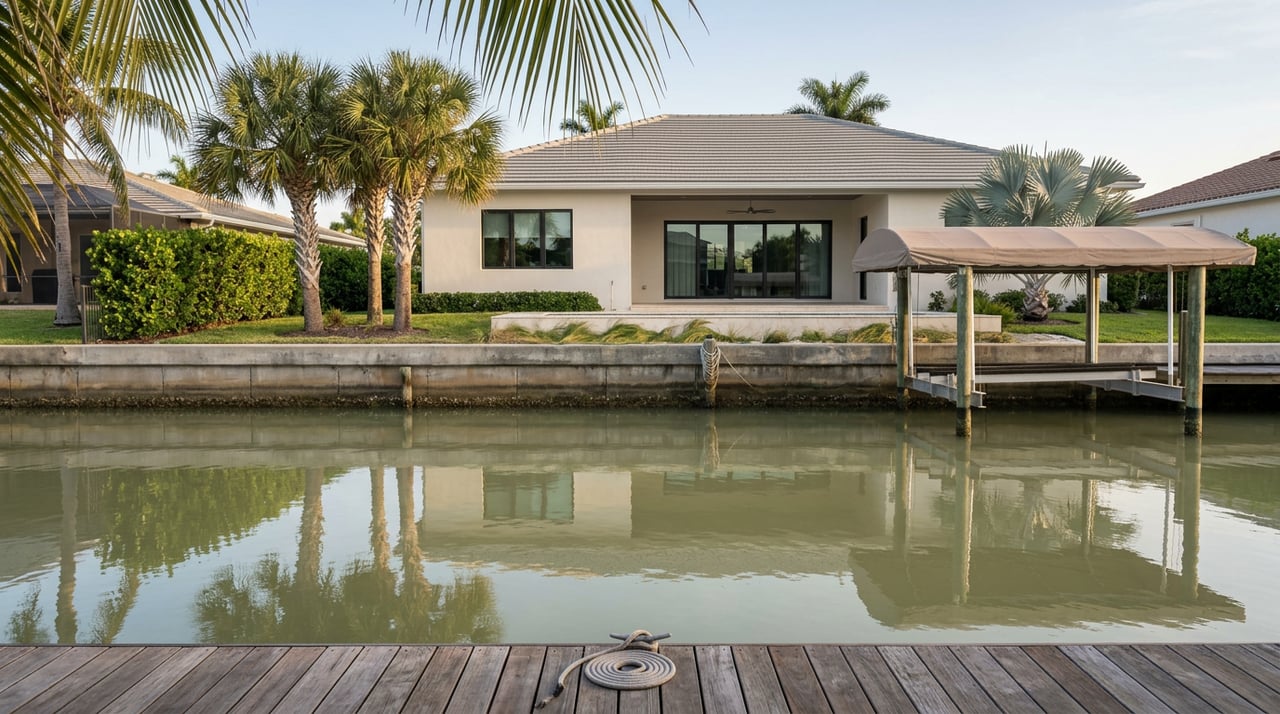
Two Isles of Capri listings can sit within a hundred thousand dollars of each other, both advertise "direct Gulf access," and support entirely different boats. One owner backs a 42-foot cruiser onto a lift outside the back door. The other keeps a 22-foot bay boat and still has to angle it carefully because the canal in front of the house is narrow and the neighbor's dock reaches almost to the centerline.
The portal price does not explain that gap. The county code, the canal width, and the seawall status do. For a buyer comparing Capri listings in the roughly $308,000 to $4.5 million range currently on the market, this is the single most useful thing to understand before writing an offer.
Collier County's Land Development Code, section 5.03.06, governs what can stick out from a residential shoreline. It is not a footnote. It is the reason two lots on the same street can command different premiums.
On manmade canals 60 feet or less in width that are not reinforced by a vertical seawall or bulkhead, dock facilities may protrude up to 33 percent of the width of the waterway. Measurement is made from the most restrictive of the property line, bulkhead line, shoreline, seawall, rip-rap line, control elevation contour, or mean high water line.
Read that carefully. On a narrower canal without a seawall, a dock plus the boat itself cannot cross a third of the water. On lots with 60 feet of water frontage or more, the side setback for the dock is 15 feet, which further constrains beam and length. Any boathouse tops out at 15 feet in height, must be open on all four sides, and only one is allowed per site. State permits from the Florida Department of Environmental Protection must be in hand before Collier County will issue a building permit for the structure.
None of this appears in an MLS remark. All of it decides whether the vessel a buyer wants to own can actually live at the property.
Capri sits on four dredged and connected mangrove islands with no HOA on the single-family stock, which is why the housing mix runs from modest 1950s cottages to new three-story luxury builds. The frontage a lot happens to have was set decades ago and cannot be improved with money. It sorts the inventory into roughly three tiers.
| Frontage type | What it supports | Where the premium comes from |
|---|---|---|
| Interior canal, seawalled | Center-console or bay boat with careful beam matching; dock length capped by setbacks and protrusion rules | Entry point to the island; cheapest way onto Capri water |
| Bay-front or wider water | Larger cruisers and lifts in deeper water, less protrusion constraint from the 33% rule | Deeper water, less shared navigation with neighbor docks |
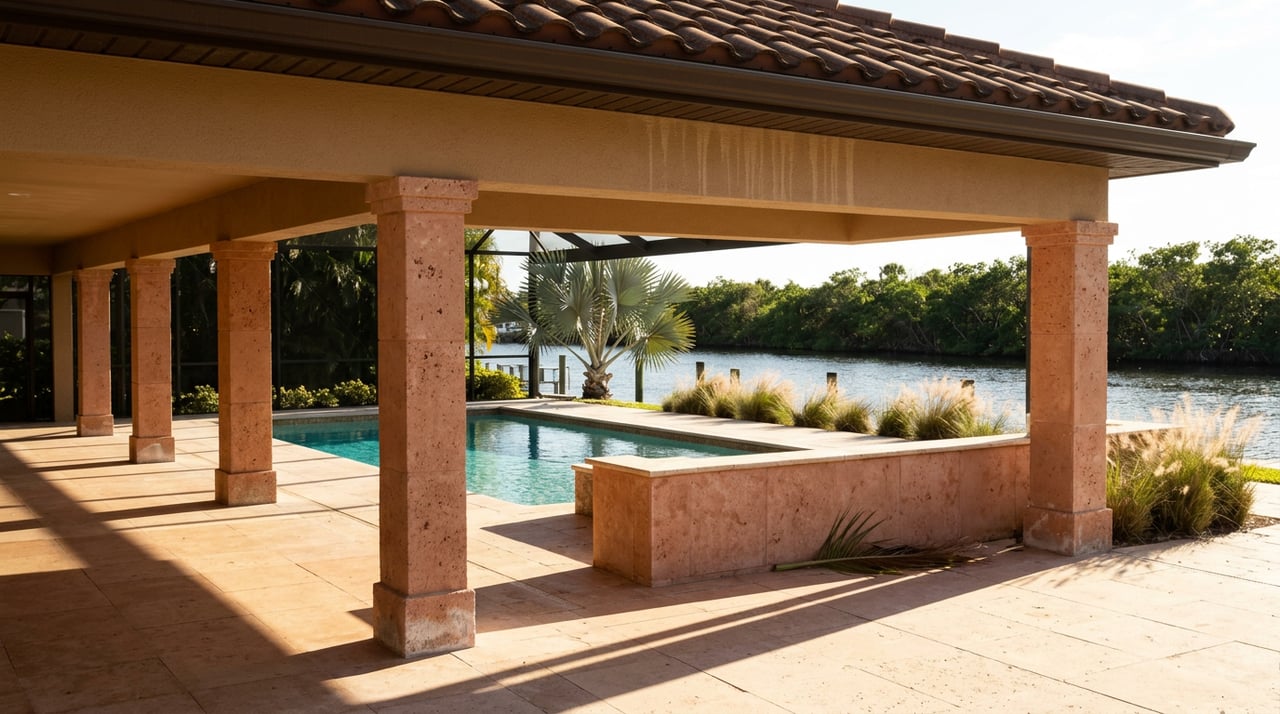
| Tip lot with wrapping frontage | Long docks with multiple lifts, sometimes 100 feet of composite decking, southern exposure options | Rare inventory, view corridors, direct sightlines to the Gulf |
A recent Capri listing with 100 feet of private composite dock and two lifts sits in the third tier. A bayfront home marketed as a "yachter's dream" with 120 feet of direct-access water frontage and an 80-foot dock sits there too. The buyer paying for either is paying for the water in front, not the drywall behind. This is why a smaller cottage on a bay tip can trade higher per square foot than a larger interior-canal home two streets over.
For years, the practical Capri question was binary. Either a buyer had the right lot for the right boat, or they kept a slip at Isles of Capri Marina, Pelican Bend, or across the water at Marco Island Yacht Club. The new Capri Harbor development being built on the island shifts that calculus. Plans call for roughly 55,000 square feet of indoor dry storage for boats up to 50 feet and approximately 80 wet slips, on a footprint totaling around 165,000 square feet.
For a buyer comparing an interior-canal home priced in the $700,000s against a bay-front home closer to $2 million, the dry-storage option changes the trade. A smaller Capri house plus a dry-storage contract can now deliver a larger boat than the private dock on the smaller lot would ever have supported under §5.03.06. That is a genuinely new lever in the market, and it has not yet fully priced into the interior-canal inventory. Patient buyers can find real value there while sellers of those homes continue benchmarking against bay-front comps that do not apply to them.
The friction in a Capri transaction is almost never the house. It is the water. A structured pre-offer checklist saves the biggest surprises for the seller, not the buyer.
Items three and four are the ones most out-of-area buyers underestimate. The buyer who wants a 38-foot express cruiser and picks a lot on a 60-foot canal without a seawall is going to be disappointed by county math regardless of what the listing agent's photos show.
As of March 2026, Capri showed roughly 50 active properties for sale with an average asking price near $1.3 million, a low near $308,000, a high at $4.5 million, and an average of about $654 per square foot. The Naples market at large, per Redfin's May 2026 read, was moving at a median of about $1.3 million with 83 days on market, and Collier County's 2026 conforming loan limit sits at $832,750, which puts most Capri single-family purchases into jumbo financing territory.
Interpreted through the frontage lens, that $308,000 to $4.5 million spread is not one market. It is three. The bottom of the range is condominium inventory and interior lots without meaningful boating capacity. The middle is competent interior-canal single-family homes, some with functional docks that fit a mid-sized boat. The top is bay-front and tip inventory where the water in front does most of the pricing work, and where the buyer pool includes cash purchasers who are indifferent to the jumbo threshold. Homes in the middle tier are where the current market gives patient buyers the most room, particularly if the intended boat can live in the new Capri Harbor dry-storage program rather than at the seawall.
Between showings on the island, there are only a handful of places to sit down. Island Gypsy Café, Capri Fish House, Pelican Bend, and Osteria Capri handle the four-restaurant total most guides refer to. The paddlecraft park at Collier Boulevard and Capri Boulevard is the free public entry point for smaller watercraft. La Peninsula, the gated condominium community at the tip of the island, controls 22 deeded boat slips across its buildings, which is worth knowing if a condo buyer wants a slip that is genuinely attached to the unit.
Does no HOA on Capri single-family homes mean no rules on the dock? No. The county code and DEP still apply. What the absence of an HOA changes is the rental profile of the home and the pace of exterior changes, not the dock permitting path.
Can the 33% protrusion limit be extended? The county code provides a boat dock extension procedure, but approvals turn on specific conditions of the property, water depth, seagrass, and the impact on neighbors. It is not a formality, and a buyer should not underwrite a purchase on the assumption that an extension will be granted.
Is buying a lot and building better than remodeling? Sometimes. Vacant Capri lots currently list from roughly $425,000 to $2.2 million, with the top of that range on the widest frontage. Construction timelines, elevation requirements, and DEP timelines for a new dock all extend the calendar. For buyers who have a specific boat and a specific view in mind, building is worth pricing against a comparable resale.
Buying a Capri home well means matching the boat, the lot, and the county code before matching the finishes. If you are weighing two listings that look similar on paper and want a straight read on what each will actually support, Maria Oddy walks the property line, reads the survey, and puts the boat on the drawing before an offer goes out. Schedule a Consultation to start that conversation.
Stay up to date on the latest real estate trends.
With my results-driven approach, disciplined negotiation strategies, excellent work ethic, and natural communication skills, I know how to fight for the terms you deserve. This is precisely why my clients have trusted me with their properties in Naples and Marco. The process works, and I make it a seamless and simple experience for you.